From Siraha To Kathmandu
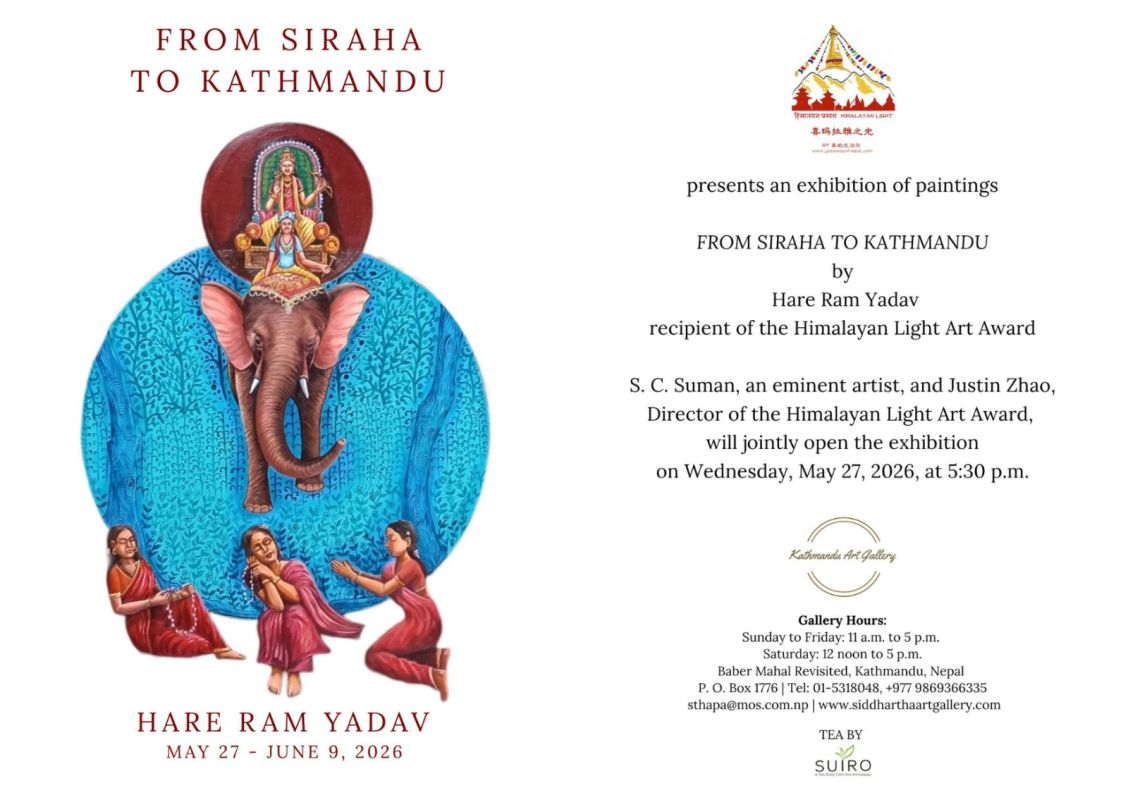
Gallery Statement
Born in Lahan, in the fertile plains of the Madhesh, where Mithila art still thrives as part of daily life, Hare Ram Yadav grew up nurtured by tradition – the rituals, sacred lines, symbols and stories on the walls. Before it entered museums and galleries, Mithila art existed on clay walls, floors of homes and within the ceremonies of ordinary people – a visual language passed from one generation of women to another for centuries. Following the devastating 1934 earthquake and the cultural shifts that ensued, these paintings gradually moved from mud walls to paper and canvas, carrying with them the memory of an entire Mithila civilisation. His earlier solo exhibition Colour of Culture at The Art Gallery Café in 2023 introduced an artist negotiating two parallel inheritances – one rooted in the formal discipline of contemporary fine arts education and the other in the deeply rooted visual traditions of Mithila culture.
From Siraha to Kathmandu unfolds a visual chronicle of Mithila life and beliefs. Artworks representing Mithila cultures and Chhath Puja, religious significance, and sacrosanct rituals associated with the Madheshi calendar offer an intimate, rather than dramatised, perspective on the sacredness of the ceremony from the viewpoint of those who practise it. The sacred sagas of the Mahabharata, Ramayana, Shaivite traditions, the cyclical nature of the seasons, nature, harvest, family, and the daily struggles of people in Siraha are visible in Yadav's paintings, such as Govardhan Puja, Sama Chakeba, and Maithali Bibah. Yadav’s paintings convey the richness of symbolism inherent in Mithila culture, including its marriage ceremonies. In works inspired by the Jhijhiya dance, Yadav turns his attention to collective feminine energy and the continuity of performative traditions that remain vulnerable in a rapidly changing society.
Threaded throughout the exhibition are the ordinary objects and rituals that shape daily rural life: the Dheki, the earthen Chulo, the bond between farmer and ox, and the Nag Panchami symbols pressed onto household walls during the monsoon season, which link rain and the mythical serpents that aid a bountiful harvest. These symbols are not presented as decorative motifs but as living cultural memory — reminders of a civilisation whose relationship with clay, ritual and land remains inseparable. Using Lok Devta Salhesh, he references the mythic king worshipped before in the Madhesh as an idol of justice, love and resistance—establishing it within the mythological and social histories long excluded from mainstream narratives in Nepali art.
Hare Ram Yadav is the recipient of the Himalayan Light Foundation Art Award 2024 and the National Fine Art Award 2021. He is part of a generation of artists who have had to face the delicate state of inherited traditions in an increasingly secular and fast-paced world. Instead of romanticising the historical past of Mithila culture, he strives for a higher level of understanding and sensitivity, delving into both its visual form and the spiritual importance of preserving these connections today. With this exhibition, Yadav brings together the two worlds that have shaped him — the fields and festivals of Siraha and the studios and galleries that have proudly shared the importance of Mithila culture. The result is a body of work that speaks with clarity, conviction and cultural intimacy, affirming Mithila art not as a relic of tradition but as a living and evolving contemporary practice.
Gurung in 2019, Lavkant Chaudhary in 2020, Jagdish Moktan, Priyanka Singh Maharjan in 2021, and Subas Tamang also in 2021. Suresh Basnet and Riti Maharjan are recipients of the award in 2022. Hareram Yadav from Siraha, a visual artist, is a recipient of the award in 2024.
Sangeeta Thapa
Founder / Director
Kathmandu Art Gallery / Siddhartha Arts Foundation
and Pinak Shrestha
Artist Statement
The five-thousand-year-old traditional folk-art style "Mithila art" has been gradually evolving from clay walls and murals to paper and canvas after the 1960s.
The Mithila region is a vast territory that lies in both India and Nepal. The religion has a rich historical, cultural, and spiritual traditions. I have painted folk deity-related themes such as Chhath festival, Govardhan Puja, Sama-Chakhewa, Jhijiya dance, etc.
As an artist born in this artistic land and closely related to the beauty and importance of Mithila art, I have used the lines, patterns, shapes, forms, colors and images of materials that are used daily in my creations. These are not only a means of decoration, use and beauty, but also an integral part of the Mithila lifestyle. We, the people of Mithila, who have been entwined with clay for ages, are living symbols of the historical, collective memory and cultural identity of Mithila.
In the current situation (modern times) where spiritual and cultural aspects are becoming weaker, I have tried to show the importance and feelings of consciousness, sensitivity, cultural awareness, fragrance and a beauty based on Mithila art in this secular and social life through my artworks.
Hare Ram Yadav